
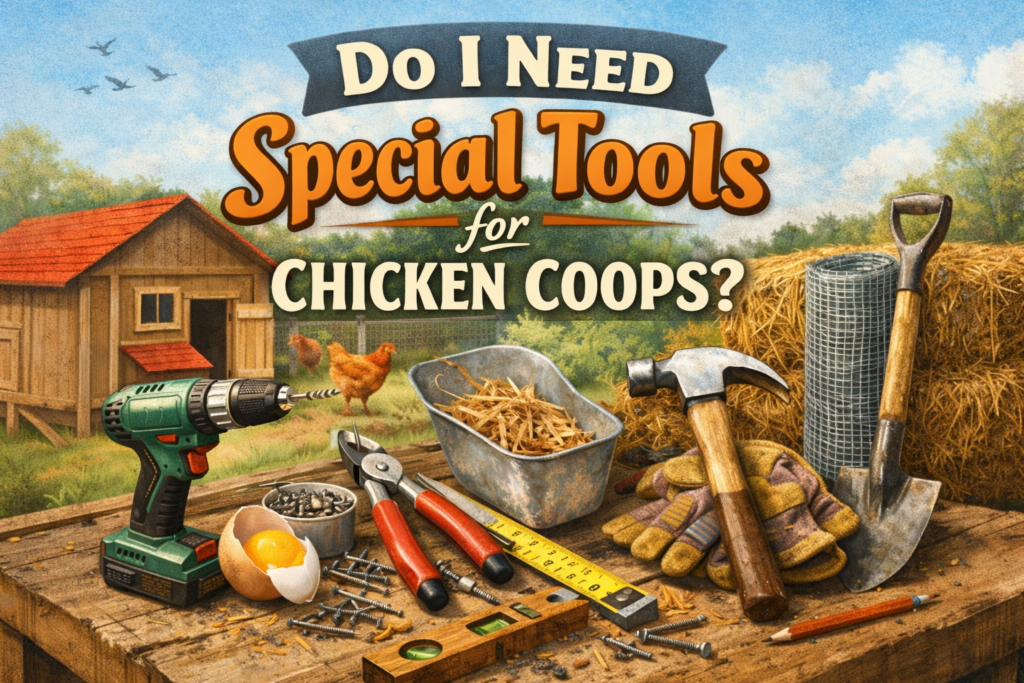
This is one of the first questions people ask once they decide to keep chickens!
You picture a cute little coop in the yard. Then your brain jumps straight to a garage full of expensive tools you do not own.
So let’s slow that down.
Do you need special tools to build a chicken coop?z
Short answer: probably not.
Long answer: it depends on what you are building and how complicated you want to make it.
The basic truth
Most backyard chicken coops are just small wooden structures. Think shed, but smaller and simpler. If you have ever built a shelf, a raised garden bed, or a basic workbench, you are in familiar territory.
The core tools most people use are pretty standard:
- Drill or impact driver
- Circular saw or handsaw
- Tape measure
- Level
- Hammer
- Square
- Pencil
That is it for most builds.
You do not need a table saw. You do not need a nail gun. You definitely do not need a full woodworking shop.
Could those tools make it easier? Sure. Necessary? Not really.
What if I have almost no tools?
This is where people get stuck.
Maybe you own a drill. Maybe not even that.
You can still build a coop. It just changes how you approach it.
If you buy lumber pre-cut from a store, or use a well-written plan that gives you exact measurements, you can get the store to cut a lot of pieces for you. Most big box stores will do a few cuts for free. They are not always precise, but for a chicken coop, we are not building kitchen cabinets.
There are also coop plans, like the Chicken Coop Plans available on ClickBank, that break everything down step by step. The value there is not fancy design. It is clarity. You are not guessing where boards go or how things line up. That matters more than having expensive tools.
You can build a solid coop with:
- A basic drill
- A cheap circular saw
- A tape measure
That is enough to get started.
Do I need a nail gun?
People love nail guns.
They are fast. They are satisfying. They make you feel like you know what you are doing.
But screws are usually better for beginners. They hold tight. They are forgiving if you mess up. You can back them out and try again.
With a drill and exterior screws, you can build the whole thing.
If you have a nail gun already, use it. If you do not, do not go buy one just for a coop.
What about fancy roofing tools?
Nope.
Most small coops use simple roofing materials. Corrugated metal panels, asphalt shingles, or even pre-made panels. A drill and roofing screws handle metal. A hammer works for shingles.
You are not roofing a house. It is a small structure. Keep it simple.
The tool you actually need
This might sound obvious, but the real tool is a plan.
When people struggle building a coop, it is rarely because they lack a specialized tool. It is because they are guessing.
They eyeball spacing. They underestimate how heavy a door will be. They forget about ventilation. Or they build something that looks cute but is a pain to clean.
That is where structured plans help. Something like the Chicken Coop Plans package gives you layouts, material lists, and measurements. You can follow along instead of improvising every step. That reduces mistakes, which reduces the need to redo things, which reduces the temptation to think you need better tools.
Good instructions matter more than fancy equipment.
What about cutting angles and weird joints?
You might see coops online with decorative trim, steep roof pitches, or complicated nesting box setups.
You do not need that.
A basic rectangular frame with a sloped roof is enough. Chickens do not care about architectural flair. They care about being dry, safe from predators, and having a place to roost.
Straight cuts. Simple joints. Screws through framing boards.
If you can cut a straight line, you are fine.
And if your line is not perfectly straight, the chickens still will not care.
Predator-proofing tools
This is one area where people overthink things.
To predator-proof a coop, you mainly need:
- Hardware cloth
- Wire cutters
- Staple gun or screws with washers
A basic manual staple gun is cheap and works well. You do not need a pneumatic one. You are attaching mesh, not framing a house.
Honestly, securing hardware cloth properly is more about patience than tools. Overlap seams. Cover openings. Check for gaps.
It is boring work. It is also important.
What if I want it to look nice?
Here is where tools can creep in.
If you want decorative siding, trim, custom windows, and paint-grade finishes, then yes, more tools make life easier. A miter saw for clean trim cuts. A brad nailer for small pieces. Sanding tools for smoother edges.
But this is optional.
There is a big difference between a functional coop and a Pinterest coop.
I say this gently because I had to tell myself the same thing. The chickens do not care if the corners are perfectly mitered.
Tool quality matters less than you think
You do not need contractor-grade equipment for a one-time build.
A basic homeowner drill will handle it. A budget circular saw will cut framing lumber just fine.
As long as the tool is safe and works properly, you are good.
The only thing I would not cheap out on is the tape measure. A flimsy one is annoying and throws off measurements. That sounds small, but it adds up fast.
Renting or borrowing
If there is one tool you need for a specific step, consider borrowing it.
Friends. Neighbors. Family.
Or rent from a local hardware store. Renting a miter saw for a day costs far less than buying one you may never use again.
There is no rule that says you must own everything.
What if I am not “handy”?
This is the slightly uncomfortable part.
Building a chicken coop is not advanced carpentry. But it does require patience and willingness to measure twice and fix mistakes.
If you absolutely hate working with tools, it might feel harder than it needs to be.
That said, a coop is actually a great first project. It is small. It is forgiving. If a board is slightly crooked, nobody files a complaint.
And if you are following clear plans, especially something structured like the Chicken Coop Plans from ClickBank, you are not inventing the process from scratch. You are assembling pieces in order.
That reduces stress more than any power tool ever will.
So do you need special tools?
For most backyard coops, no.
You need a handful of basic tools, decent instructions, and some patience.
You do not need a workshop. You do not need professional gear. You do not need to turn into a carpenter.
You need a way to measure, a way to cut, and a way to fasten boards together.
After that, it is mostly about keeping things square, keeping things dry, and remembering that the goal is safe shelter for your birds.
Everything else is extra.